Building a minimum viable product requires balancing speed, architectural longevity, and budget. At TechFiyr in Mirpur DOHS, Dhaka, we build production-grade mobile apps and SaaS platforms for clients across the US and Europe. When founders ask us about the real financial commitment required to launch a product, we skip the fluff and look at the actual engineering hours. Read on to see our pricing breakdown, or explore our shipped mobile apps to review our production track record.
Why choose Flutter for an MVP in 2026?
Flutter remains our primary tool for cross-platform apps because it compiles directly to native ARM machine code using the Dart language. Unlike JavaScript-bridge frameworks, Flutter gives you true 60fps (and 120fps on modern ProMotion displays) UI performance without the jank. For a startup, writing one UI codebase means you launch on both the Apple App Store and Google Play Store simultaneously, cutting your QA and feature-parity cycles in half.
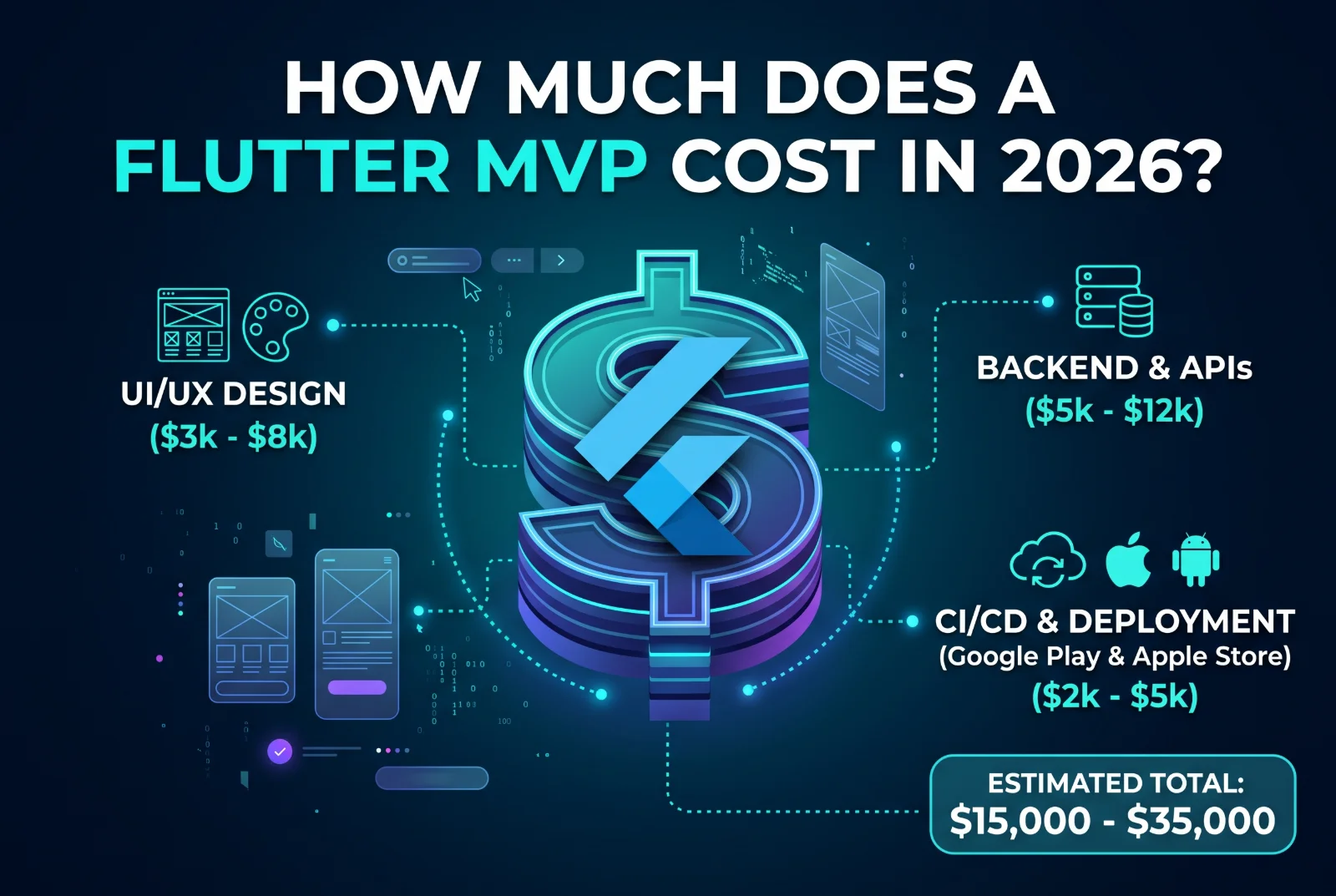
Here is how a typical budget breaks down across engineering phases:
| Project Phase | Estimated Cost (USD) | Timeline | Deliverables |
|---|---|---|---|
| UI/UX & Architecture | $3,500 - $7,000 | 1 - 2 weeks | Figma wireframes, design system, state management plan |
| Frontend (Flutter/Dart) | $8,000 - $20,000 | 3 - 5 weeks | Cross-platform views, offline caching, local state |
| Backend & APIs | $5,000 - $12,000 | 2 - 4 weeks | Node.js/Go or Firebase, auth, database, REST/GraphQL |
| CI/CD & App Store Launch | $1,500 - $3,000 | 1 week | Automated builds, TestFlight, Play Console release |
How does UI/UX design impact your Flutter MVP budget?
Skimping on UI/UX design guarantees high user churn. We design using atomic design principles in Figma, making sure your widgets map cleanly to Flutter's native layout engine. A standard MVP needs 10 to 25 core screens. Spending 1 to 2 weeks here prevents expensive rewrites during the coding phase. We establish a robust design system early, defining typography, color tokens, and custom widget atoms.
What drives the cost of the Flutter frontend?
The frontend cost scales with state management complexity and hardware integrations. If your app simply consumes REST endpoints and displays lists, development moves fast using Riverpod or Bloc for state management. However, integrating Bluetooth Low Energy (BLE), WebSockets for real-time chat, or complex offline-first SQLite synchronization adds engineering hours.
// Example of clean Riverpod state management in our Flutter MVPs
final userProvider = StateNotifierProvider<UserNotifier, UserState>((ref) {
  return UserNotifier(ref.watch(authRepositoryProvider));
});
How much should you budget for backend and infrastructure?
Your backend choices dictate your recurring cloud costs and initial development speed. For rapid MVPs, we often deploy serverless architectures using Firebase or Supabase to handle authentication, Firestore/PostgreSQL databases, and edge functions. For clients requiring custom business logic or heavy data processing, we spin up containerized Node.js or Go microservices deployed on AWS via Docker.
How do automated CI/CD pipelines prevent App Store rejection?
Manual deployment wastes engineering hours and introduces human error. We configure automated CI/CD pipelines using Codemagic or GitHub Actions combined with Fastlane. Every push to main runs unit and widget tests, bumps version numbers, and pushes builds directly to Apple TestFlight and Google Play Internal Testing tracks.
Ready to turn your product concept into production-ready code? Book a technical discovery call with our lead engineers in Dhaka today.